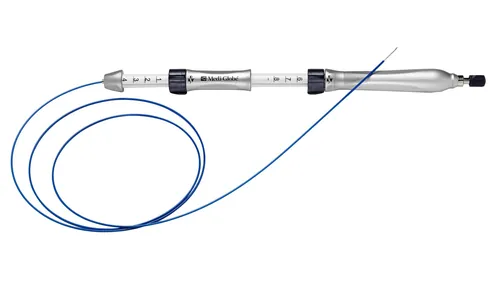
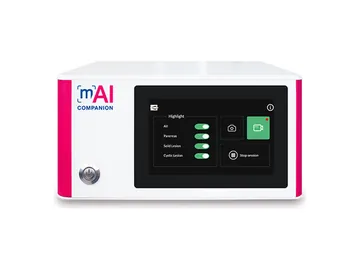
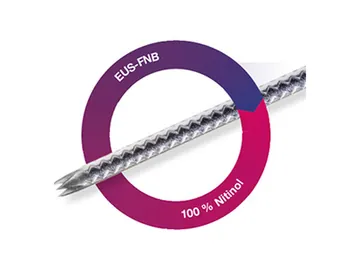
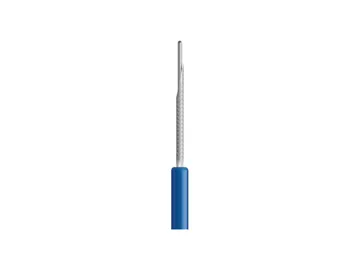
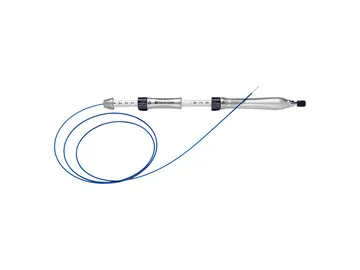
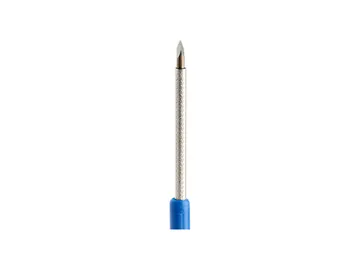
EUS Needles & Systems

Which needle for which job: FNB, FNA, access and drainage items. The needle selector matches the type a guideline recommends for a target with the needles we supply.

This page is intended for healthcare professionals.

EUS Needles & Systems
Procedure

An EUS tissue sampling case, step by step

EUS-guided tissue sampling of a solid mass in the pancreatic body: six steps from finding the target to assessing the sample, and the separate path taken when access is needed instead of sampling.

gastric lumengastric wallheadpancreatic bodytail portal confluencelymph node main pancreatic ductsplenic veinsplenic veinmass
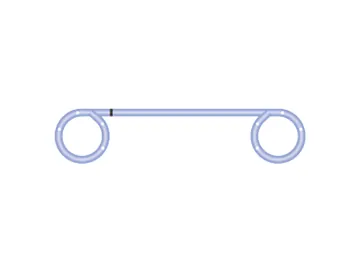
Schematic section, not to scale: the echoendoscope is in the stomach and the image plane cuts the pancreatic body along its long axis (patient's right on the left). Bottom left: product close-up; bottom right: the B-mode ultrasound image of the same plane.
  1. 01

    Finding the target, checking the path with Doppler

    The linear echoendoscope images the pancreatic body from the stomach, the mass looks hypoechoic, and the needle path is checked for vessels with colour Doppler.

    Clinical detail

    The linear echoendoscope is advanced into the stomach; when needed its tip balloon is filled with water and the transducer is placed against the posterior gastric wall. The image shows the pancreatic body, the splenic vein and portal confluence behind it and the main pancreatic duct within it; the mass appears as a hypoechoic area. The needle path is checked for vessels with colour Doppler. For the pancreatic head and uncinate process the scope works from the duodenum; the same principle applies to lymph nodes and subepithelial lesions.

  2. 02

    Choosing and loading the needle

    The 2025 ESGE update recommends end-cutting FNB needles for solid pancreatic lesions; where rapid on-site evaluation (ROSE) is available, FNA needles still have a role.

    ESGE 2025

    Clinical detail

    For solid pancreatic lesions the 2025 ESGE update recommends end-cutting FNB needles; where rapid on-site evaluation (ROSE) is available, FNA needles still have a role. Routine sampling uses 22G or 25G; when a core is the aim, a 19G or a 22G FNB needle is used. The needle is attached to the working channel with the stylet in and the needle locked; the sheath is advanced until its tip shows just beyond the elevator on the endoscopic image, then locked.

    The needle type guidelines recommend for each target, and our needles of that type: needle selector

  3. 03

    Puncture and stylet

    The needle is followed as a bright line into the mass, where the stylet is withdrawn; ESGE suggests using the stylet with FNB needles.

    Clinical detail

    The needle is advanced through the gastric wall into the mass, followed in real time as a bright line on the image. The stylet keeps the needle lumen closed while it crosses the wall and is withdrawn once the needle is in the mass. ESGE makes no recommendation for or against the stylet with FNA needles and suggests using it with FNB needles.

  4. 04

    Sampling: to-and-fro and fanning

    The needle moves to and fro in the mass, shifting angle each stroke (fanning); suction is the physician's choice, closed before the needle leaves.

    Clinical detail

    The needle is moved to and fro within the mass; with each stroke the angle is changed slightly with the up-down knob or the elevator, so that different areas of the mass are sampled (fanning). The suction method is the physician's choice: dry suction with a syringe, slow withdrawal of the stylet (slow-pull), or wet suction with the needle primed with saline. Suction is closed before the needle leaves the mass; a VacLok aspiration syringe comes in the pack.

  5. 05

    Retrieving and assessing the sample

    The sample goes onto slides and into a tube; ESGE 2025 recommends on-site cytology (ROSE) with FNA and visual core inspection (MOSE) with FNB.

    ESGE 2025

    Clinical detail

    The needle is drawn back into the sheath, locked and removed from the scope; the sample is expressed with the stylet or air onto slides and into a tube. Rapid on-site evaluation (ROSE) tells adequacy during the procedure; without ROSE, looking at the white core by eye (MOSE) helps the decision on another pass; ESGE 2025 recommends ROSE with FNA and MOSE with FNB. ESGE suggests that assessment should not be limited to smear cytology but include histological preparations such as a cell block or formalin-fixed tissue fragments.

  6. 06

    Another pass if needed

    Without ROSE, ESGE 2025 suggests 2 passes with an end-cutting FNB needle, 3 with a reverse-bevel FNB needle and at least 4 with FNA.

    ESGE 2025

    Clinical detail

    If the sample is not adequate, a new pass is made with the same needle into another area of the mass. Without ROSE, ESGE 2025 suggests 2 passes with an end-cutting FNB needle, 3 with a reverse-bevel FNB needle and at least 4 with an FNA needle. The target, the needle and on-site assessment set the number of passes; the decision is the physician's.

    Source: Facciorusso A et al. ESGE, Endoscopy 2025;57:390-418 (PMID 40015316)

  7. 07

    When access or drainage is needed instead of sampling

    Entering a pseudocyst, bile duct or pancreatic duct is a separate path: 19G access needle, 0.035 inch guidewire, a dilated tract and a stent.

    Clinical detail

    Entering a pseudocyst, the bile duct or the pancreatic duct is a separate path. The target is punctured with a 19G access needle, the stylet is removed and a 0.035 inch guidewire is coiled into the space through the needle; the tract is dilated and kept open with a stent. This section covers sampling; access and drainage steps are described separately.

This section is intended for healthcare professionals. The steps are summarised from the ESGE tissue sampling guideline (2021) and the ESGE technical review (2025); indication, technique and product choice are the physician's decision, and each product's instructions for use apply.

Needle selector

FNA or FNB? EUS needles by target

First the difference between the two needle types, then the type the guidelines recommend for each target, and last our needles of that type. The guideline rows name the needle type; our needles are matched only by purpose and tip.

Two needle types, two different samples

The tip geometry decides what comes back. The drawings are schematic.

Fine-needle biopsy FNB

Aims for a tissue core with preserved architecture, for histology and immunohistochemistry.

Tip, on-site evaluation, passes
Tip
End-cutting (Franseen type, fork tip) or reverse bevel
On-site evaluation
MOSE is recommended; ROSE is not needed with end-cutting needles [1] ESGE 2025 · strong recommendation, moderate quality
Passes
2 with end-cutting, 3 with reverse bevel [1] ESGE 2025 · strong recommendation, moderate quality [4] Chalhoub 2024 · meta-analysis, 19 RCTs, 3,552 patients

The guideline in brief. For solid pancreatic masses, ESGE 2025 prefers end-cutting FNB needles over reverse-bevel FNB and FNA (strong recommendation, high quality evidence); where on-site cytology (ROSE) is available, FNA keeps a role [1].

Other guideline statements

ASGE 2024 also prefers FNB over FNA and 22G over 25G [2]. For lymph nodes and autoimmune pancreatitis, end-cutting FNB is suggested (conditional, very low quality); for subepithelial lesions of 20 mm or more, FNB and mucosal incision-assisted biopsy are recommended equally [1] [3].

Choose your target

Each row shows the needle type the guideline recommends for that target and the level of evidence. When you choose a row, our needles of that type are brought forward below.

Target
Liver parenchymal biopsy is outside the scope of ESGE 2025, so it has no row.
How to read the level of evidence (GRADE)
Strong recommendation
What the guideline panel words as "recommend": most informed physicians would choose this for most patients.
Conditional (weak) recommendation
"Suggest": the choice may vary with the patient, the centre and the resources.
High quality
High confidence that the true effect lies close to the estimate; further research is unlikely to change it.
Moderate quality
The true effect is probably close to the estimate, but may be substantially different.
Low quality
Confidence in the estimate is limited; the true effect may be substantially different.
Very low quality
Very little confidence in the estimate; usually based on observational or indirect data.

Guidelines grade a recommendation on two axes: the strength of the recommendation and the quality of the evidence behind it. A strong recommendation can rest on low quality evidence, and a conditional one on high quality evidence. [10]

Our needles of this type

Matching uses only the purpose and tip recorded for each product; it is not a recommendation.

3 orderable needle families

Coming soon

Write to us for information

All dimensions and comparison 9 models
Dimensions of all models
ModelProductPurposeTipNeedleSheath (mm)ShaftNeedle extensionGuidewireStyletUltrasound visibilitySUT
GUB-33-21-019TopGain EUS FNBFNBCrown cut, 3 point19G · 1.1 mm2.1Stainless steel0 to 8.5 cm0.030 inRound tipSpecially treated surface (manufacturer statement)GS1810
GUB-33-18-022TopGain EUS FNBFNBCrown cut, 3 point22G · 0.7 mm1.8Stainless steel0 to 8.5 cm0.018 inRound tipSpecially treated surface (manufacturer statement)GS1810
GUB-33-18-025TopGain EUS FNBFNBCrown cut, 3 point25G · 0.5 mm1.8Stainless steel0 to 8.5 cmNot statedRound tipSpecially treated surface (manufacturer statement)GS1820
GUS-33-21-019ProControl EUS FNAFNANot stated19G · 1.1 mm2.1Stainless steel0 to 8.5 cm0.030 inRound tipSpecially treated needle, coloured sheath (manufacturer statement)GS1810
GUS-33-18-022ProControl EUS FNAFNANot stated22G · 0.7 mm1.8Stainless steel0 to 8.5 cm0.018 inRound tipSpecially treated needle, coloured sheath (manufacturer statement)GS1810
GUS-33-18-025ProControl EUS FNAFNANot stated25G · 0.5 mm1.8Stainless steel0 to 8.5 cmNo valueRound tipSpecially treated needle, coloured sheath (manufacturer statement)GS1820
GUA-34-21-019AccessPro EUS accessAccessBlunt cannula, trocar cut stylet19G · 1.1 mm2.1Stainless steel0 to 8.5 cm0.035 inNitinol, trocar cutNot statedGS1810
(coming soon)TopGain Flex EUS FNBFNBCrown cut, 3 point22G / 0.7 mm1.8 and 2.7Nitinol0-8.5 cmNot statedNot statedNot statedNot stated
(coming soon)ProFlex EUS FNAFNANot stated22G / 0.7 mm1.8 and 2.7Nitinol0-8.5 cm0.018 inNot statedZig-zag laser engravingNot stated

Dimensions from the manufacturer's catalogues and instructions for use registered in Türkiye; SUT (Turkish reimbursement) codes from the national device registry export (03.10.2026). "Not stated" means our documents do not give the value. The guideline rows are at needle-type level and are not a recommendation for any product listed. The instructions for use decide selection and compatibility; needle choice is the physician's decision. This section is intended for healthcare professionals.

References (10)
  1. Guideline (GRADE) Facciorusso A et al. EUS-guided tissue sampling: ESGE Technical and Technology Review. Endoscopy 2025;57:390-418. PMID 40015316. doi.org/10.1055/a-2524-2596
  2. Guideline (GRADE) Machicado JD et al. ASGE guideline: solid pancreatic masses. Gastrointest Endosc 2024;100:786-796. PMID 39387777. doi.org/10.1016/j.gie.2024.06.002
  3. Guideline (GRADE) Deprez PH et al. Endoscopic management of subepithelial lesions: ESGE Guideline. Endoscopy 2022;54:412-429. PMID 35180797. doi.org/10.1055/a-1751-5742
  4. Meta-analysis, 19 RCTs, 3,552 patients Chalhoub JM et al. Effect of the number of passes on diagnostic performance of EUS-FNB of solid pancreatic masses: systematic review and meta-analysis. Gastrointest Endosc 2024;100:595-604. PMID 38852683. doi.org/10.1016/j.gie.2024.05.022
  5. Network meta-analysis, 16 RCTs, 1,934 patients Gkolfakis P et al. Comparative diagnostic performance of end-cutting FNB needles for EUS tissue sampling of solid pancreatic masses: a network meta-analysis. Gastrointest Endosc 2022;95:1067-1077. PMID 35124072. doi.org/10.1016/j.gie.2022.01.019
  6. Multicentre RCT (non-inferiority), 771 patients analysed Crinò SF et al. EUS-FNB with or without ROSE for solid pancreatic lesions: a randomized controlled non-inferiority trial. Gastroenterology 2021;161:899-909. PMID 34116031. doi.org/10.1053/j.gastro.2021.06.005
  7. Meta-analysis, 9 studies, 1,276 patients Facciorusso A et al. EUS FNB vs FNA for lymph nodes tissue acquisition: systematic review and meta-analysis. Gastroenterol Rep 2022;10:goac062. PMID 36340808. doi.org/10.1093/gastro/goac062
  8. Network meta-analysis, 8 RCTs (patient count not in the abstract) Facciorusso A et al. Comparative diagnostic yield of endoscopic techniques for tissue sampling of upper GI subepithelial lesions: a network meta-analysis. Endoscopy 2024;56:31-40. PMID 37591258. doi.org/10.1055/a-2156-0063
  9. Guideline (GRADE) van der Merwe SW et al. Therapeutic endoscopic ultrasound: ESGE Guideline. Endoscopy 2022;54:185-205. PMID 34937098. doi.org/10.1055/a-1717-1391
  10. Methods paper Guyatt GH et al. GRADE: an emerging consensus on rating quality of evidence and strength of recommendations. BMJ 2008;336:924-926. PMID 18436948. doi.org/10.1136/bmj.39489.470347.AD

EUS Needles & Systems

Support in this category

Taught physician to physician, supported in the room for the first cases, supplied nationwide.