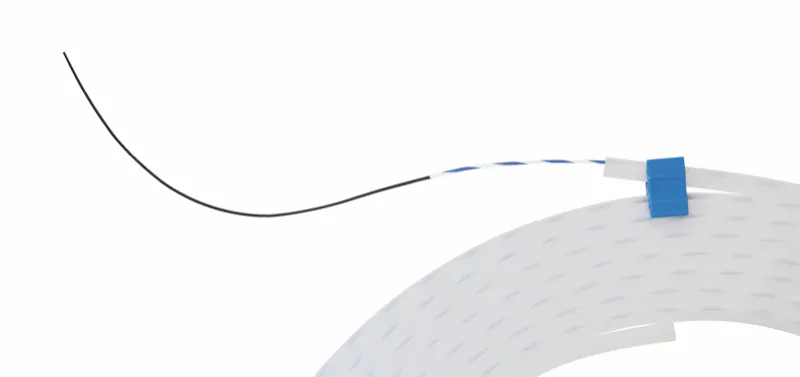
An ERCP guidewire (also called a biliary guidewire) is a single-use wire that holds access in the bile duct or the pancreatic duct during ERCP. Catheters, sphincterotomes and stents are exchanged over it. The wires on this page have a flexible, radiopaque tip and come in two families, stainless steel and Nitinol. Urology guidewires are separate products.
This page is intended for healthcare professionals.
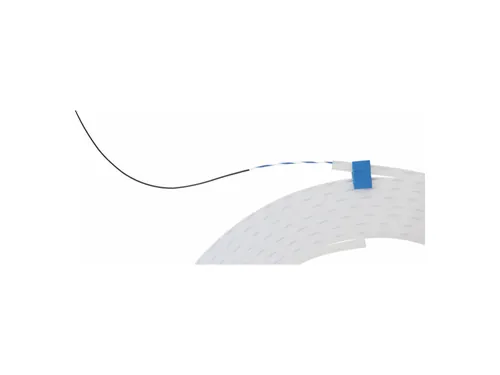
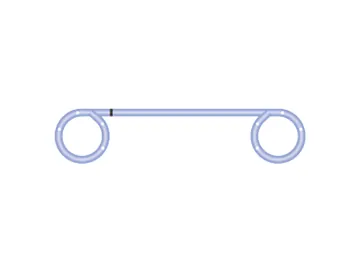
Schematic, not to scale
| Diameter (inch) | Length (cm) | Material | SUT code | Model |
|---|---|---|---|---|
| Nitinol | ||||
| 0.035 | 450 | Nitinol, Smart-Guide | GS2460 | 21635450 |
| 0.035 | 450 | Nitinol, High-Flex | GS2060 | 21735600 |
| No size data | Nitinol | No code | 21735450 | |
| Stainless steel | ||||
| No size data | Stainless steel | No code | 21025400 | |
| No size data | Stainless steel | No code | 21035300 | |
| No size data | Stainless steel | No code | 21035400 | |
A range of single-use guidewires used to maintain and direct access across biliary and pancreatic strictures during ERCP, in stainless steel and in Nitinol.
An ERCP guidewire, also called a biliary guidewire, is a thin wire placed in the bile duct or the pancreatic duct that holds access while instruments are exchanged. Catheters, sphincterotomes and stents are exchanged over it. The term guidewire is also used in other fields; this page is only about ERCP.
Both materials are supplied: three stainless steel models and three Nitinol ones. The Nitinol wires are kink resistant, which is what a tortuous duct asks for; the stainless steel family is the stiffer one.
This page does not call any of these wires MR safe. On one of the six models the label carries an MR unsafe statement. The other five carry no MR statement at all, which is not the same as being safe. A wire is in any case removed at the end of the procedure.
The two Nitinol wires with their measurements in the table are 0.035 inch and 450 cm. On this site the pages of the ERCP catheter, the sphincterotomes, the stone extraction balloon, the guidewire versions of the stone extraction basket and the pancreatic stent give a guidewire of up to 0.035 inch. Which accessory takes which wire is written in the guidewire row of its page and in its instructions for use.
The instructions for use of the sphincterotome say that, for the guidewire sphincterotomes, the guidewire is strongly recommended to be withdrawn into the tube while high-frequency current is used, to avoid possible voltage induction on the guidewire. This page makes no statement about electrical insulation of the wires.
We do not publish a list price on this page. The price depends on the model (Nitinol or stainless steel), the diameter, the length and the quantity. To get a quote, use the Request an export quote button in the Export and Bulk Orders block at the bottom of this page, and give the model code, the quantity and the destination country.
Melekırmak, an Istanbul-based medical device distributor, offers these ERCP guidewires. The manufacturer is Medi-Globe / Endo-Flex. The page lists six models, three Nitinol (among them High-Flex 21735600 and Smart-Guide 21635450) and three stainless steel. For availability, documentation and lead time in your country, use the Request an export quote button at the bottom of this page and name the model, the quantity and the destination country.
Based in Istanbul, Türkiye, we supply hospitals nationwide and answer international enquiries. Ask us about availability, documentation and lead times in your country.
Updated: 09.11.2026