The generator drives the blade at 55 kHz; tissue in the jaw heats, coagulates and is divided in one closure.
This page is intended for healthcare professionals.
Three parts stay in the theatre and one is discarded after the case.

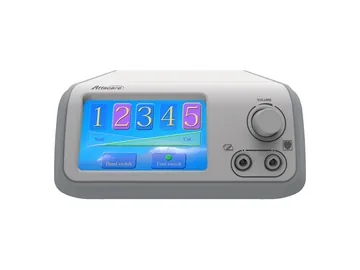
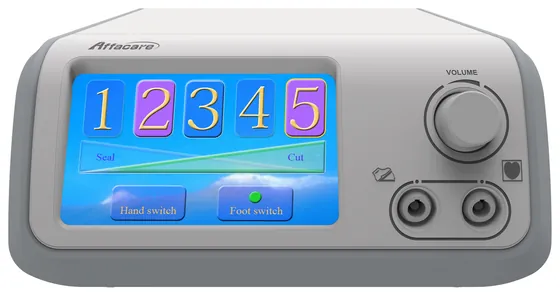
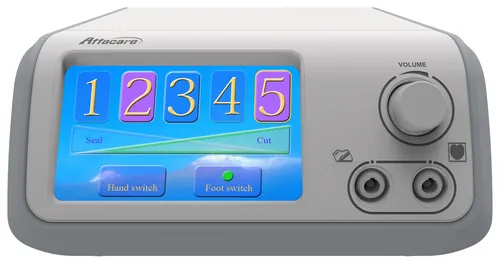
Touch screen with five power levels, voice prompt with volume control, and an alarm that stops the output. Service life 6 years, foot switch AH-618 included.

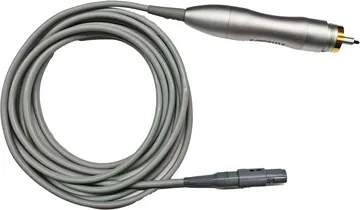
Turns the electrical energy into mechanical vibration. It ships non-sterile and is reprocessed; the manufacturer limits it to 100 uses.

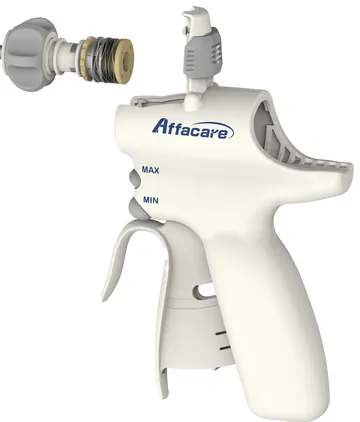
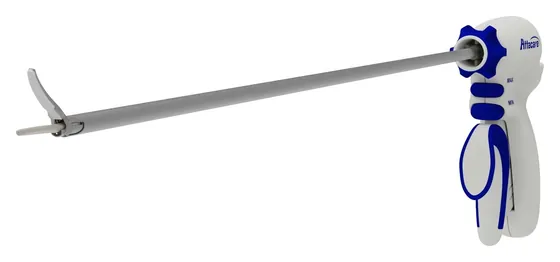
The reusable handle the AH-631 shears are seated in: trigger, MAX and MIN buttons, hatch gate and gate lock.

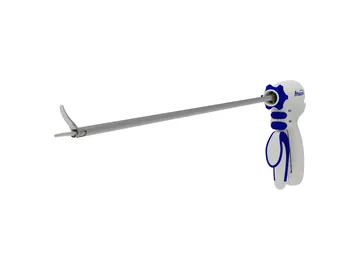
Laparoscopic lengths of 14, 23, 36 and 45 cm and the 9 cm open-surgery scissors. Each one is discarded after the case.
The generator converts mains electricity into the drive signal that the transducer turns into vibration. Five levels sit on the screen: level 1 is the lowest power and level 5 the highest, and the manufacturer describes level 5 as the faster cutting speed and level 1 as the better haemostasis.
Output is started from the handle or from the pedal, whichever the surgeon prefers, and the screen shows the level that is set. The generator runs a self-test at startup, tracks the drive frequency continuously and independently of the load, and stops the output with an alarm when it reads an abnormal state. The name of this tracking is the ATT algorithm.
The left pedal activates maximum power and the right pedal the lower level; the foot switch is rated IPX8. The service life of the generator with its foot switch is 6 years, and the transducer is not to be used more than 100 times.
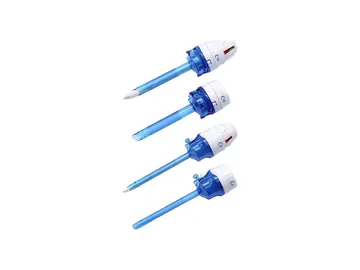
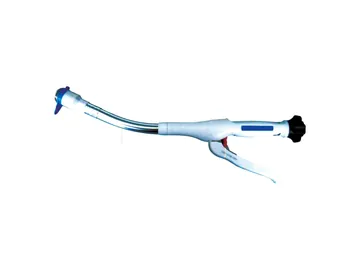
The laparoscopic instrument goes through a CE-marked trocar whose inner diameter is over 5.5 mm and reaches the field at 14, 23, 36 or 45 cm, coagulating vessels up to and including 3 mm in diameter. The same jaw arrives in two builds: the AH-638-B carries its own trigger handle, and the AH-631 is the shaft alone, seated in the reusable handpiece AH-636-B. The model table and the rest of the detail are on the Ultrasonic Laparoscopic Shears page.
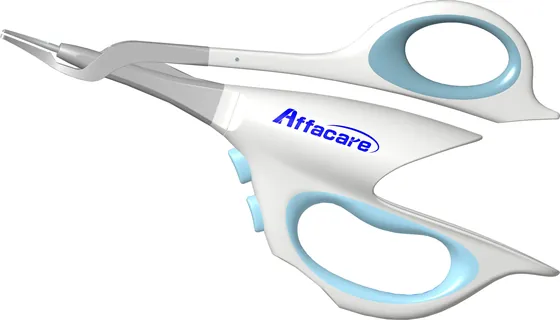
The AH-637-9 has no trigger handle. Its body is a scissors frame with a clamp and the MAX and MIN buttons sit on the shell, so the hand that holds it also sets the power; its working length is 9 cm and it coagulates vessels up to and including 5 mm in diameter. It seats on the same AH-616 transducer as the laparoscopic instruments. The indication, the model record and the regulatory note are on the Ultrasonic Open Surgery Scissors page.
The indication is soft tissue incision where bleeding control is wanted and thermal injury to the tissue is to be kept minimal. That covers open and laparoscopic general, gynecologic, urologic and thoracic procedures, and the vessel diameter the instrument is rated for decides which model goes on the trolley.
Nine contraindications stand against it, and four of them shape the case list: the device is not indicated for bone incision, and it is not intended for pediatric patients. Patients on aspirin, warfarin or another anticoagulant are asked to stop at least two weeks before the procedure and to have coagulation reassessed. The device is not indicated for contraceptive tubal occlusion either. The full list is in the instructions for use.
Four steps, and the fourth one is the waste bin.
The generator runs its self-test at startup and opens the home screen. You pick the level there and choose whether the handle or the pedal will start the output.
The transducer screws onto the instrument and the torque wrench in the pack tightens the connection; no other tool is used and the connection is not forced. Every part is checked for damage, and the online test is run before the case.
The jaw closes on the tissue and the blade vibrates. The instrument is not closed and activated without tissue in the jaw, and the tissue is not pulled or twisted while it runs.
The tip and the rod stay hot after activation, so the front part is not touched. The instrument is single use: it is not cleaned, not disinfected and not sterilized, and it goes into medical waste after the case.
This page names the models supplied in Türkiye under the brand AFFACARE: generator AH-611, transducer AH-616, handpiece AH-636-B, the AH-631 and AH-638-B shears, and the AH-637-9 open-surgery scissors. Models not supplied in Türkiye are not shown on this page. The system is declared to the basic safety and essential performance requirements of IEC 60601-1:2020.
TÜV Rheinland LGA Products GmbH, the notified body identified by the number 0197, issued the manufacturer the EU certificate HZ 2107604-1 on 29 September 2025, under Annex IX Chapters I and III of Regulation (EU) 2017/745. It is valid to 28 September 2030, and the Class IIb products in its scope include ultrasonic surgery instruments and single-use devices for surgery with an ultrasonic generator. The manufacturer's EUDAMED single registration number is CN-MF-000025388 and its European authorised representative is Prolinx GmbH in Germany.
The manufacturer's quality management system is certified to EN ISO 13485:2016 under SX 2107604-1, from 27 May 2025 to 26 May 2028. Its scope is the design, manufacture and distribution of the ultrasonic surgical system generator, the soft tissue ultrasonic transducer, the handpiece and the single-use handpiece tip.
Which document covers which model is the question a purchasing unit asks, and the answer differs by model. We send the registration documents, the EU certificate HZ 2107604-1 and the instructions for use together with the model table, so the answer arrives as a document.
Melekırmak is the Türkiye distributor of Affacare. The system and the single-use instruments on this page can be ordered; the generator is supplied by sale or by placement, according to what the unit asks for, and the conditions are in the quotation.
The document file goes to your purchasing unit in one piece: the instructions for use of four families, the EU certificate HZ 2107604-1, the registration documents and the model table. Questions about the working lengths, the trocar requirement and the transducer's limit of 100 uses are answered from those documents.
The team that seats the transducer and changes the instrument is your own team. At the installation and at the first cases our clinical support team stands in the procedure room, and the torque wrench, the self-test and the empty-jaw rule are worked through there.
Updated: 21.09.2026