A step between medication and surgery in gastroesophageal reflux disease (GERD): full-thickness plication (eFTP) from inside the stomach.
This page is intended for healthcare professionals.
Patients with proven reflux who depend on a proton pump inhibitor (PPI) to keep their symptoms under control and who cannot take PPI long term or do not want lifelong medication, and are not surgical candidates yet.
The manufacturer describes the indication as GERD with a hiatal hernia of up to 3 cm that is not well controlled with medication, or where long-term medication is not an option. The randomised GERDX trials enrolled PPI-dependent patients; in the Gut 2022 trial their symptoms were controlled on PPI and most had non-erosive reflux disease. Patient selection decides the outcome.
The GERDX System creates a full-thickness plication (eFTP) at the gastroesophageal junction from inside the stomach, intended to rebuild the flap valve.
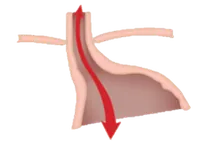
A weakened gastroesophageal junction lets gastric content reflux freely into the esophagus.
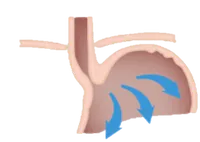
The plication is intended to rebuild the flap valve at the gastroesophageal junction.
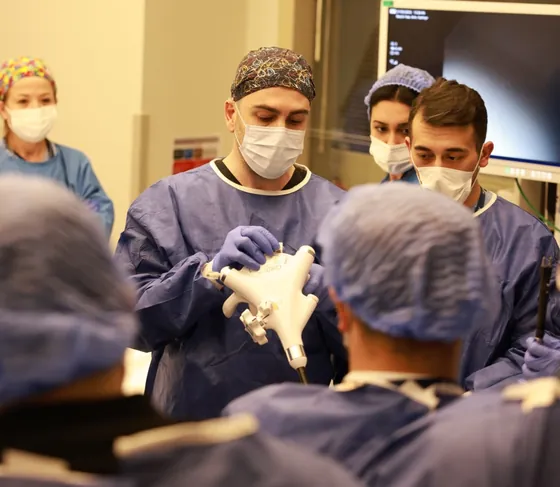
Like a gastroscopy: under deep sedation or general anaesthesia, entirely from inside the stomach, under direct endoscopic view.
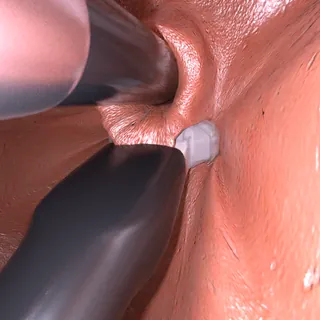
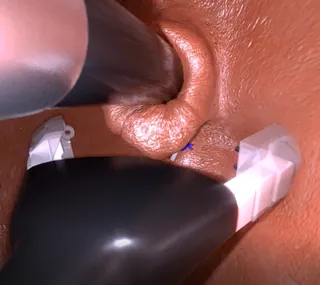
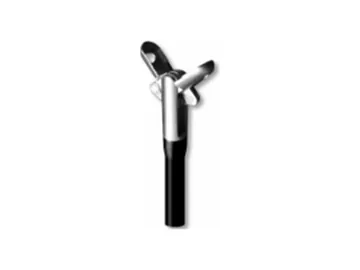
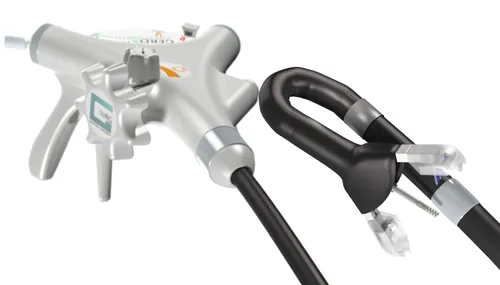
The Applicator is introduced through the mouth and oesophagus over a guidewire, and an ultra-slim endoscope is passed through its scope channel. Under direct endoscopic view its front part is fully retroflexed, the arms are opened and the Tissue Retractor is advanced toward the gastric wall.
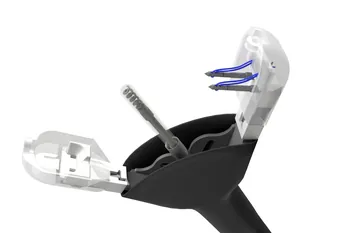
The Tissue Retractor is advanced deep into the gastric cardia; pulling it back draws the gastric wall between the open arms of the Applicator. The arm design and the centrally placed retractor gather a generous fold of tissue. Because the endoscope moves independently of the Applicator, the view is kept throughout.
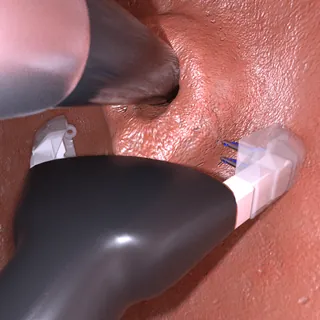
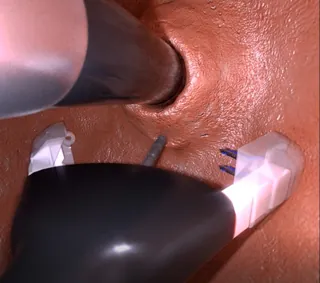
The arms are closed under view, creating a duplication through all layers of the stomach wall: endoscopic full-thickness plication, eFTP. The suture passes through every layer so that the fold holds, and the Applicator lets you reposition the Suture System before it is deployed permanently.
The pre-tied transmural pledget suture holds the full-thickness duplication at the gastroesophageal junction; wrapping the tissue this way is intended to rebuild the flap valve. The Tissue Retractor is removed, the arms are closed again, and the Applicator is straightened and withdrawn.
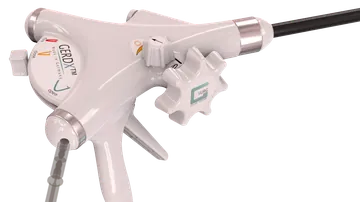
Four components, ordered separately: the applicator, the suture system, the tissue retractor and the guide wire. An ultra-slim endoscope of at most 6 mm runs inside the applicator and moves independently of it.

A flexible instrument introduced over a guidewire, with the endoscope running inside its scope channel. Cables can only pull; the patented micro-hydraulic drive also pushes and holds, so tissue grasping, approximation and suture deployment come from one slim instrument.

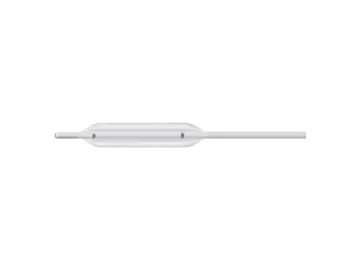
Housed in the distal tip, stainless steel with a polycarbonate sheath. After the arms open, a rotating movement takes it into the muscle layer and pulls the wall between the arms for a true full-thickness bite; a movable sheath limits the depth.

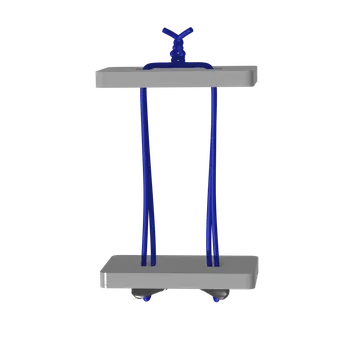
A pre-tied transmural suture carried on the arms, non-resorbable, in two systems: a single filament polypropylene USP 2-0 and a multifilament polyester USP 0, pre-tied over titanium retention bridges. Two 10×6 mm ePTFE pledgets spread the contact pressure over the constantly moving stomach wall and are designed to keep the thread from cutting through.
All three are long-established implant materials.
Two randomised sham-controlled trials and five-year follow-up with the previous-generation device.
Patients with at least 50% improvement in the GERD-HRQL score, the primary endpoint; 2.9% after the sham procedure.
Read publication → 62.8%Patients off PPI one year after the procedure; 11.4% in the sham group.
Read publication → 69.0%Patients whose acid exposure time fell below 6%; 10.3% after sham. At 6 months, 27.6% of the eFTP group and 72.4% of the sham group were on PPI.
Read publication → 67%PPI-dependent patients still off daily PPI at 60 months (20 of 30); median GERD-HRQL improved from 19 to 10.
Read publication →Melekırmak Medical is the Türkiye distributor of G-SURG GmbH. eFTP depends on patient selection and a trained team, so we run the system as a programme. The system is in use in gastroenterology units in Türkiye today.
The programme is one we build with the manufacturer: the selection criteria gone through with your team before your first case, a proctor for your first patients, then field support.
Education & Workshops| Component | Class | Shelf life (months) | Order number |
|---|---|---|---|
| Applicator | Is | 18 to 24 | 255-000-01 |
| Suture system | IIb | 24 to 36 | 801-000-01 |
| Suture system | IIb | 24 | 802-000-01 |
| Guide wire | Is | 24 to 36 | 810-000-01 |
| Tissue retractor | IIa | 24 to 36 | 820-000-01 |
Sources: Gut 2022, Kalapala, n=70, Endoscopy 2023, Maydeo, n=60, Surgical Endoscopy 2008, Pleskow, n=33
If you are a patient or a relative: only a specialist in the relevant branch can judge whether this treatment fits you. Please ask your own physician.
Updated: 29.09.2026