For healthcare professionals

Bronchoscopic Thermal Vapor Ablation (BTVA)

InterVapor® System

Segmental volume reduction in upper lobe-predominant heterogeneous GOLD III/IV emphysema with bronchoscopic water vapor. No implant is left behind.

0Implants: the catheter is withdrawn, nothing stays in the airway
3-10 sVapor per segment in STEP-UP; the IP3 plan sets the time
12 monthsControlled follow-up in STEP-UP
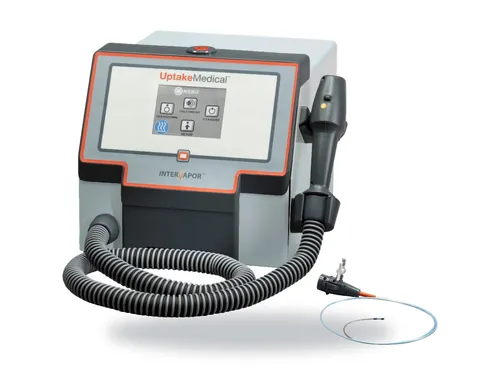
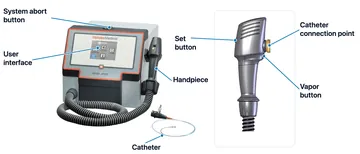
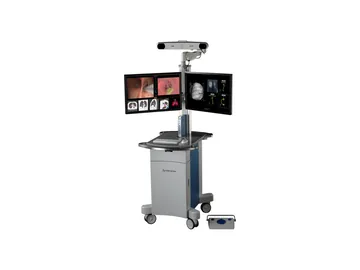
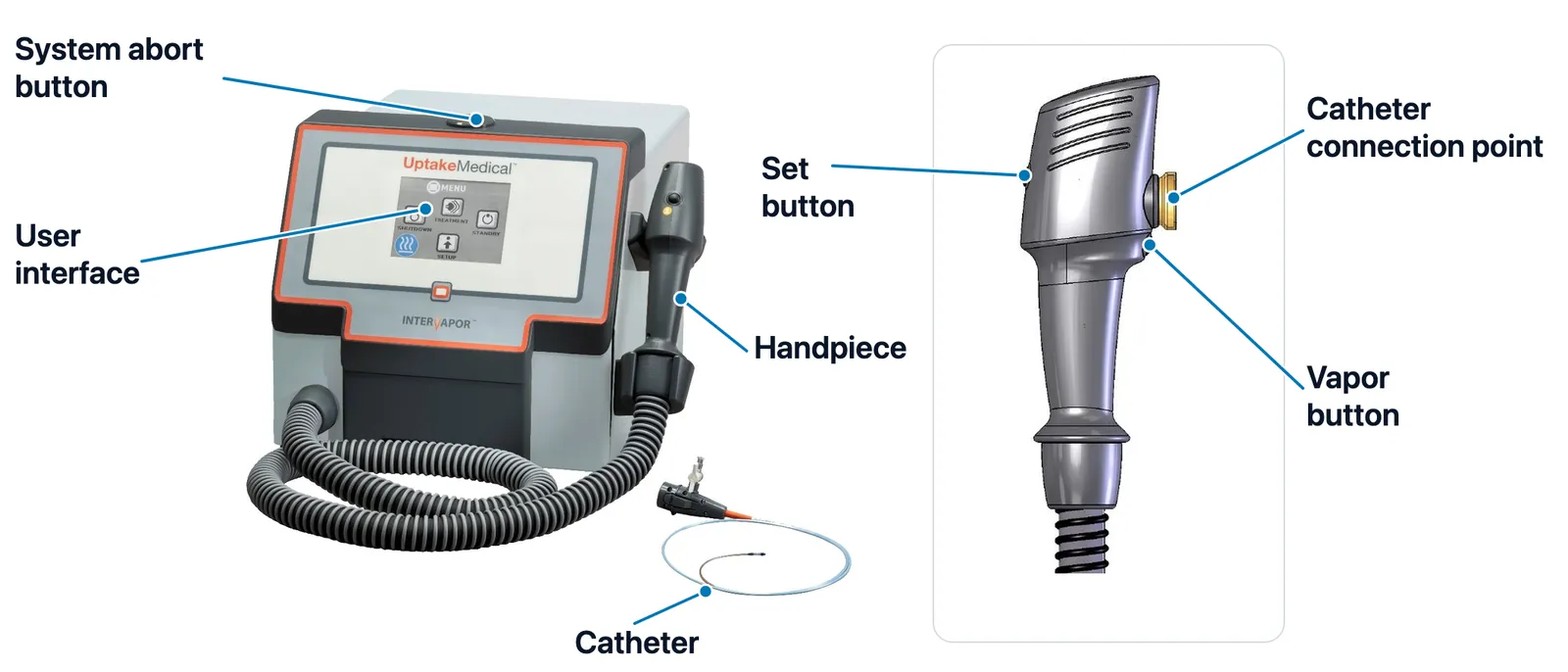
InterVapor generator with handpiece hose and single-use vapor catheter
Procedure

How is it performed?

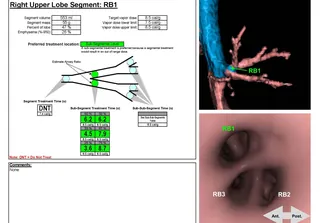
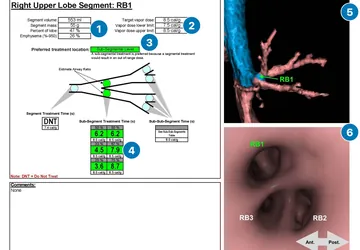
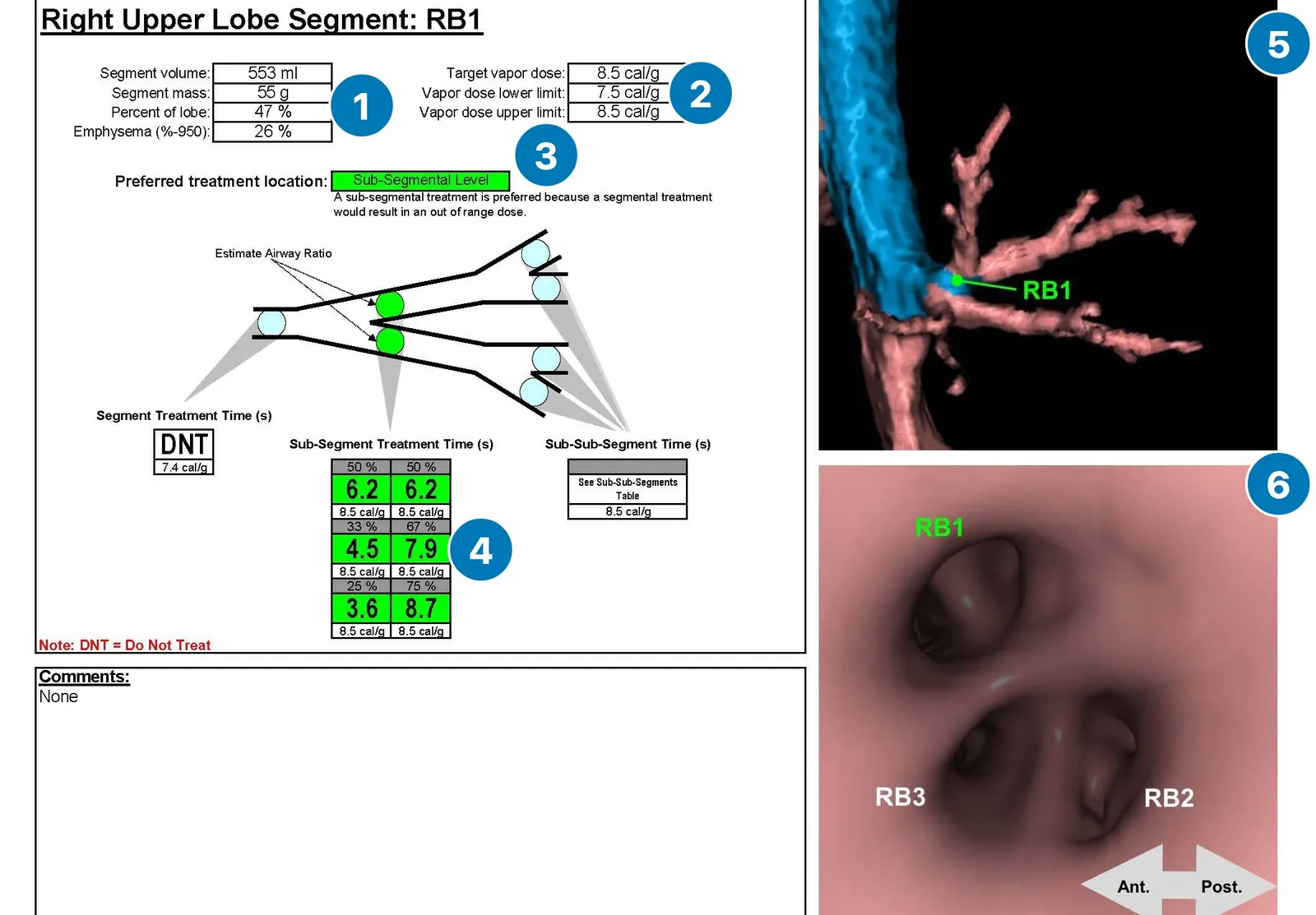
IP3 plan for segment RB1: volume, mass, emphysema score and treatment time
Step 01

Plan on the CT

An inspiratory thin-slice CT goes to the manufacturer; the IP3 plan gives volume, mass, emphysema score and vapor time for every upper lobe segment. 1 or 2 segments are chosen per procedure.

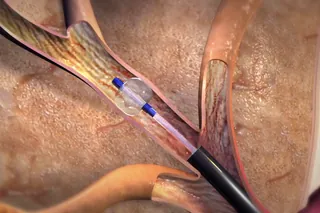
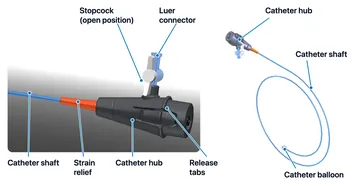
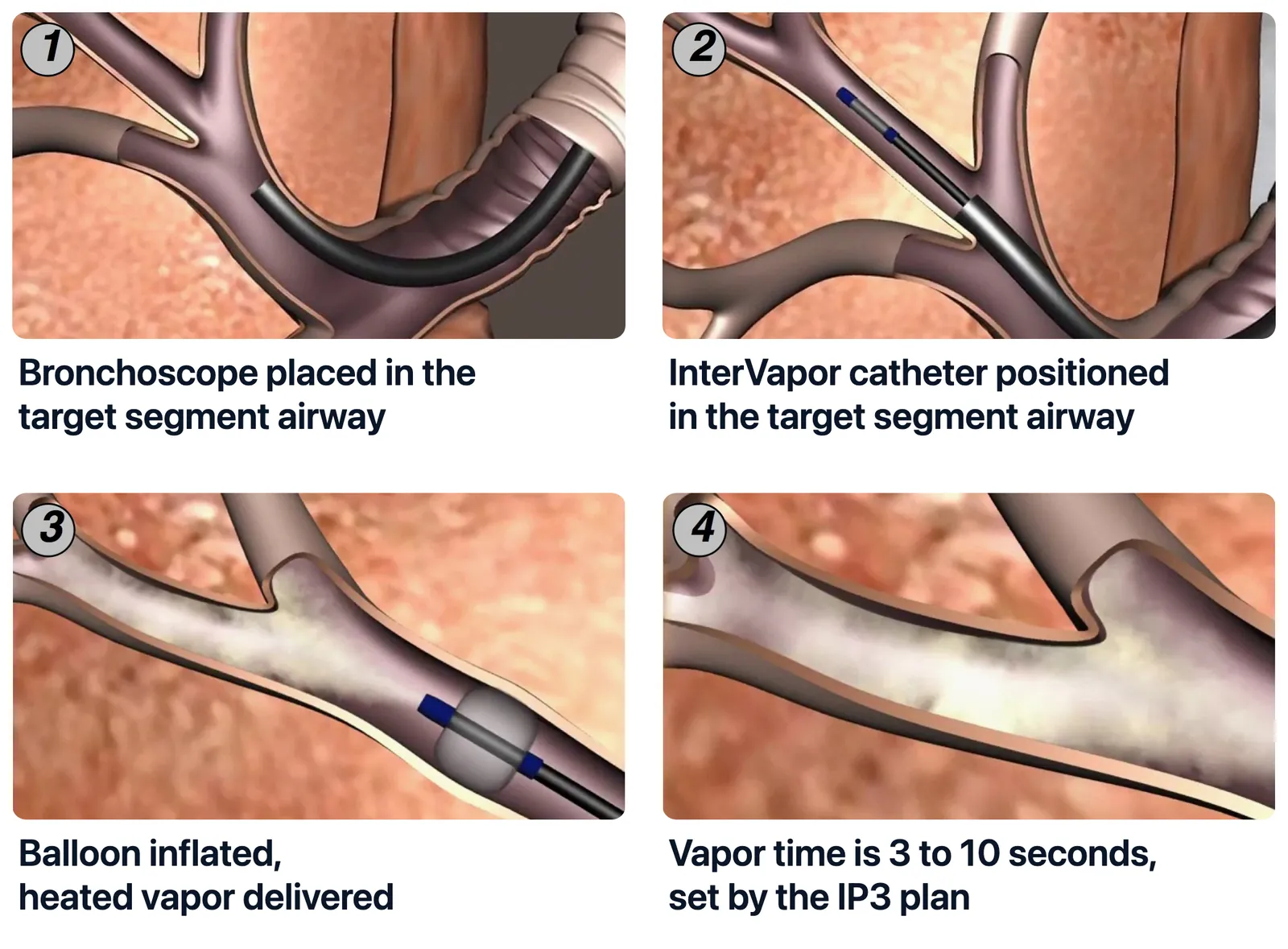
Catheter out of the bronchoscope, balloon inflated at the entrance of the target segment
Step 02

Place the catheter

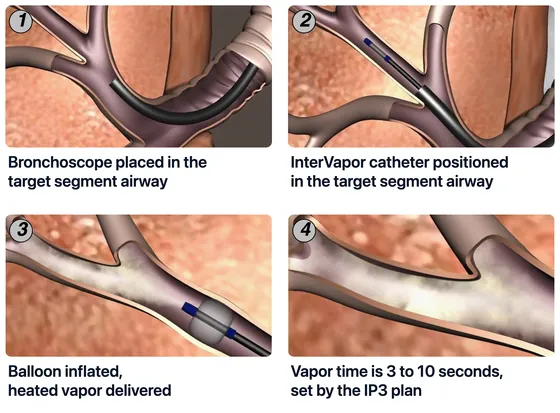
Through the working channel the catheter enters the planned segmental bronchus; the balloon is inflated at the ostium.

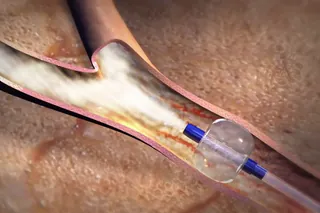
Vapor fills the segment beyond the sealing balloon
Step 03

Deliver the vapor

Heated vapor ablates the target airway and parenchyma; in STEP-UP it was delivered for 3 to 10 seconds per segment, and the IP3 plan sets the time. [1]

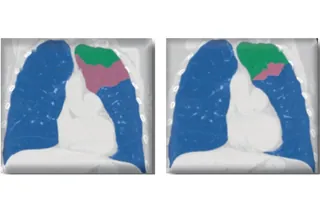
Diseased (pink) and preserved (green) segment: baseline on the left, 6 months after treatment on the right
Step 04

Follow up while the segment shrinks

The ablated tissue remodels and the segment shrinks. In STEP-UP at 6 months, segments treated in the first session had lost 42% of their volume and those treated in the second session 33%; preserved segments expanded by 11%. [1]

Follow-up per the IFU

Discharge imaging is reviewed; clinical evaluation on days 7, 14 and 28. A second procedure is possible after at least 3 months.

Schematic of the four procedure panels: bronchoscope, catheter, balloon and vapor, duration
Patient selection

Who is it for?

BTVA is indicated for heterogeneous upper lobe GOLD III/IV emphysema; fissure status was not a selection criterion in STEP-UP.

Suitable patient

  • Symptomatic despite optimized medical therapy and rehabilitation
  • Heterogeneous, upper lobe-predominant emphysema on CT
  • GOLD III/IV; STEP-UP criterion FEV1 20-45% of predicted [1]
  • Hyperinflation: RV above 150% of predicted (STEP-UP) [1]
  • Other lung volume reduction options considered

Expert panel recommendation: FEV1 20-45%, RV above 175%, DLCO at least 20% of predicted. [4]

Groups in which the IFU states safety and efficacy have not been established
  • Age below 40 or above 75
  • FEV1 below 20% or DLCO below 20% of predicted
  • BMI below 18 or above 32 kg/m2
  • RV 150% of predicted or less
  • 6-minute walk distance of 140 m or less after optimized medical management
  • PaCO2 above 50 mmHg
  • Pulmonary hypertension
  • Previous LVRS, bullectomy, transplant or lung resection; current endobronchial valves or coils
  • Homogeneous disease, unstable COPD, clinically significant bronchiectasis

Long-term safety and efficacy has not been established in clinical trials more than 12 months after treatment.

Contraindications and warnings
  • Single large bulla (over a third of the lobe) or paraseptal emphysema in the treatment lobe
  • Recent respiratory infection or COPD exacerbation; active infection
  • Concomitant illness or medication with a significantly increased risk of complications
  • Highly diseased upper and lower lobes in the contralateral lung
  • Pregnancy or breastfeeding
  • Increased bleeding risk or need for permanent anticoagulant or antiplatelet therapy; aspirin up to 100 mg a day may be continued after the procedure at the physician's assessment

Respiratory symptoms may worsen before improving; patients selected for treatment should be expected to tolerate this. The full list is in the instructions for use.

Patient selection and CT protocol
  1. Clinical assessment against the criteria above
  2. CT at full inspiration, non-contrast, helical, 16 slices or more, about 1 mm slices
  3. The CT goes to the manufacturer; the IP3 plan returns volume, mass, emphysema score and vapor time per segment
  4. 1 or 2 segments per procedure; the next procedure after at least 3 months
  5. Video bronchoscope with a working channel of at least 2.8 mm
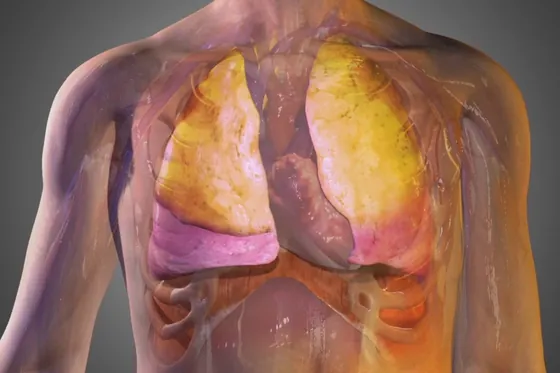
Illustration: both lungs in the chest; the hyperinflated, emphysematous upper lobes (yellow) crowd the healthier lower lobes (pink)
Clinical evidence

What did STEP-UP show?

StudyDesignPatientsFollow-upMain result versus control
STEP-UP [1]Randomised controlled versus medical management, 13 sites (Europe, Australia), 2:1, open-label70 randomised, 69 analysed (45/24)6 monthsFEV1 difference 14.7% (p<0.0001); SGRQ-C difference 9.7 points (p=0.0021)
STEP-UP, 12 months [2]Same trial, correspondence69 (45/24)12 monthsFEV1 difference 12.8% (p=0.0039); SGRQ-C difference 12.1 points (p=0.0021)
STEP-UP, incomplete fissures [3]Post hoc subgroup54 (35/19)12 monthsFEV1 difference 14.6% (p=0.0137)
GOLD 2025 [5]In select patients with advanced emphysema, bronchoscopic interventions: endobronchial valves (Evidence A); lung coils (Evidence B); vapor ablation (Evidence B)

The longest controlled follow-up is 12 months; the instructions for use state that safety and efficacy beyond 12 months has not been established. STEP-UP was open-label without a sham control and funded by the manufacturer (Uptake Medical). In the incomplete fissure subgroup the SGRQ-C difference was not significant (p=0.0712).

Surgical and Interventional Therapies in Advanced Emphysema (adapted from GOLD 2025, Figure 3.26) Surgical and interventional therapies in advanced emphysema Emphysema PredominantPhenotype with Hyperinflation Not Candidate forBullectomy, ELVR or LVRS Bullectomy Lung transplant large bulla no large bulla HeterogeneousEmphysema HomogeneousEmphysema - CV or FI+ ELVR(EBV, LVRC, VA)LVRS + CV or FI- ELVR(LVRC, VA)LVRS - CV or FI+ ELVR(EBV, LVRC, VA)LVRS + CV or FI- ELVR(LVRC, VA)LVRS Note: not all therapies are clinically available in allcountries. Long term ELVR outcomes or direct comparisons to LVRSare unknown. Definition of abbreviations: CV, collateral ventilation measureby Chartis; FI+, fissure integrity > 90% by HRCT; FI-, fissureintegrity < 90% by HRCT; ELVR, Endoscopic Lung Volume Reduction;EBV, Endobronchial Valve; VA, Vapor Ablation; LVRC, Lung VolumeReduction Coil; LVRS, Lung Volume Reduction Surgery. Adapted from GOLD 2025 Report, Figure 3.26.
GOLD 2025: surgical and interventional therapies in advanced emphysema
Surgical and Interventional Therapies in Advanced Emphysema (adapted from GOLD 2025, Figure 3.26) Surgical and interventional therapies in advanced emphysema Emphysema PredominantPhenotype with Hyperinflation Not Candidate forBullectomy, ELVR or LVRS Bullectomy Lung transplant large bulla no large bulla HeterogeneousEmphysema HomogeneousEmphysema - CV or FI+ ELVR(EBV, LVRC, VA)LVRS + CV or FI- ELVR(LVRC, VA)LVRS - CV or FI+ ELVR(EBV, LVRC, VA)LVRS + CV or FI- ELVR(LVRC, VA)LVRS Note: not all therapies are clinically available in allcountries. Long term ELVR outcomes or direct comparisons to LVRSare unknown. Definition of abbreviations: CV, collateral ventilation measureby Chartis; FI+, fissure integrity > 90% by HRCT; FI-, fissureintegrity < 90% by HRCT; ELVR, Endoscopic Lung Volume Reduction;EBV, Endobronchial Valve; VA, Vapor Ablation; LVRC, Lung VolumeReduction Coil; LVRS, Lung Volume Reduction Surgery. Adapted from GOLD 2025 Report, Figure 3.26.
The difference

Treated in incomplete fissures in STEP-UP too, and leaves no implant

  • Also analysed in collateral ventilation The vapor acts on the segment's own tissue; in a post hoc STEP-UP analysis, patients with collateral ventilation also showed an FEV1 difference versus control at 12 months. [3]
  • No implant Nothing stays in the airway; the segments left untreated remain available for a later procedure.
  • Segment by segment, staged 1 or 2 segments per procedure; the rest of the lobe can be treated at least 3 months later.
Components

What is in the system?

Your own video bronchoscope carries the catheter.

InterVapor Generator

InterVapor Generator

Turns sterile water into vapor and delivers the planned seconds of dose through the handpiece, with a countdown on screen.

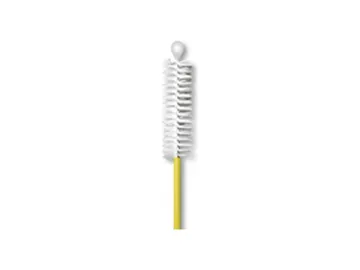
InterVapor Catheter

InterVapor Catheter

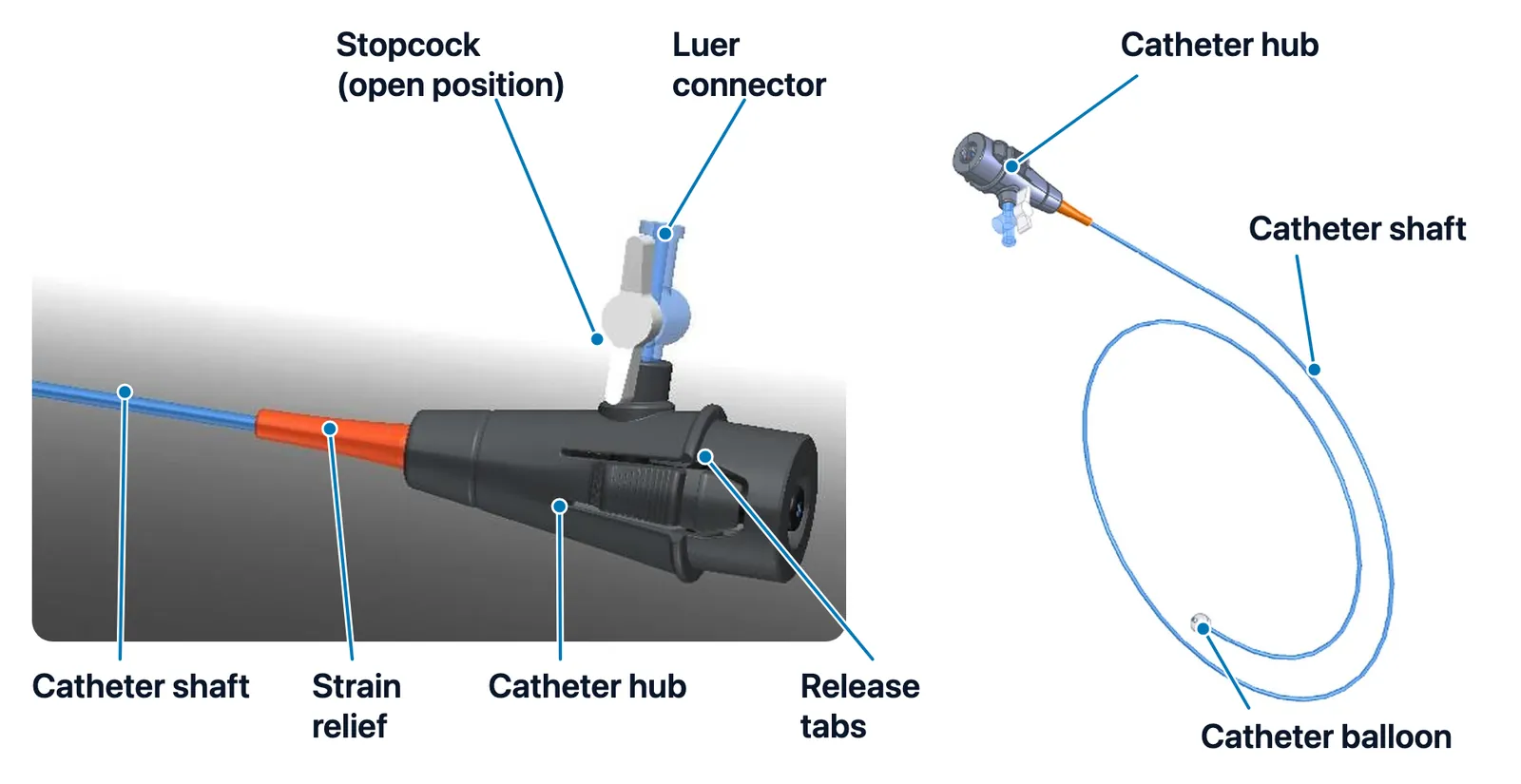
Single-use and sterile, 2.6 mm at its widest; the balloon seals the segment ostium so the vapor stays where planned.

IP3 Treatment Plan

IP3 Treatment Plan

Personalized Procedure Program: reports each segment's volume, mass and emphysema score from the CT and sets the vapor time per segment.

  1. Segment data: volume, mass, share of the lobe, emphysema score (%-950)
  2. Target vapor dose with the lower and upper dose limit (cal/g)
  3. Suggested treatment level: segment or subsegment
  4. Treatment time (s) for the segment and subsegments
  5. 3D airway with the target segment marked
  6. Virtual bronchoscopy view of the segment entrances

Measurements at a glance

Catheter outer diameter
≤ 2.6 mm
Usable length
80 cm
Working channel
≥ 2.8 mm
All technical data
What it is
A bronchoscopic thermal vapor ablation (BTVA) system: generator, single-use catheter and IP3 planning software.
Who it is for
Heterogeneous upper lobe GOLD III/IV emphysema, still symptomatic on optimal therapy.
How it is used
Bronchoscopic, 1 or 2 segments per procedure; the next procedure after at least 3 months.
Catheter
UM-CTH-100: max. outer diameter 2.6 mm, usable length 80 cm, EO sterile, single use
Bronchoscope
Video bronchoscope, working channel at least 2.8 mm
Generator
UM-GEN-100: 50 x 45 x 34 cm, 24 kg filled, 100 to 240 VAC, 750 ml reservoir
Accessories per case
One each: sterile water for inhalation or injection in a one litre bag, a single-line fluid administration set with no filter, the biopsy valve of the scope in use, a 1 ml and a 60 ml Luer lock syringe, surgical lubricant as required
CT protocol
Inspiratory, non-contrast, helical, at least 16 slices, about 1 mm

Technical data

Who makes it
Uptake Medical, a Broncus company.
Part numbers
Generator UM-GEN-100 with drain bag UM-BAG-100, catheter UM-CTH-100, procedure program UM-IP3-100; drain bags are not interchangeable

Technical data: the manufacturer's instructions for use.

References

  1. Herth FJF, Valipour A, Shah PL, et al. Segmental volume reduction using thermal vapour ablation in patients with severe emphysema: 6-month results of the multicentre, parallel-group, open-label, randomised controlled STEP-UP trial. Lancet Respir Med. 2016;4(3):185-193. doi:10.1016/S2213-2600(16)00045-X
  2. Shah PL, Gompelmann D, Valipour A, et al. Thermal vapour ablation to reduce segmental volume in patients with severe emphysema: STEP-UP 12 month results. Lancet Respir Med. 2016;4(9):e44-e45. doi:10.1016/S2213-2600(16)30199-0
  3. Gompelmann D, Eberhardt R, Schuhmann M, et al. Lung volume reduction with vapor ablation in the presence of incomplete fissures: 12-month results from the STEP-UP randomized controlled study. Respiration. 2016;92(6):397-403. doi:10.1159/000452424
  4. Gompelmann D, Shah PL, Valipour A, Herth FJF. Bronchoscopic thermal vapor ablation: best practice recommendations from an expert panel on endoscopic lung volume reduction. Respiration. 2018;95(6):392-400. doi:10.1159/000489815
  5. Global Initiative for Chronic Obstructive Lung Disease (GOLD). Global Strategy for the Diagnosis, Management, and Prevention of Chronic Obstructive Pulmonary Disease: 2025 Report (v1.0, 15 November 2024). Figures 3.26 and 3.27. goldcopd.org/2025-gold-report/

InterVapor in Türkiye

Melekırmak Medical is the Türkiye distributor of Broncus Medical. Write to our team for the literature, the technical data and the patient selection criteria. The manufacturer provides clinical support to the teams using the system.

If you are a patient or a relative: only a specialist in the relevant branch can judge whether this treatment fits you. Please ask your own physician.

Updated: 19.10.2026

Request a demo or information

Tell us about your emphysema caseload; we will go through the literature and the selection criteria.

Manufacturers: Partner with us

Call Request a demo