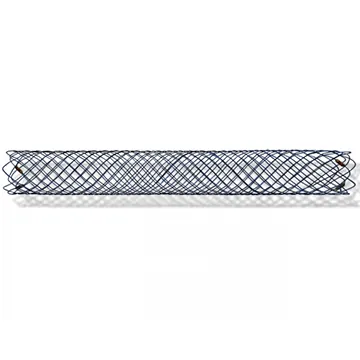
An enteral self-expanding metal stent (SEMS), also called an esophageal, duodenal or colonic stent by site, holds a stricture open. It is woven from a single Nitinol wire and placed over a guidewire. It is used for malignant strictures of the esophagus, duodenum and colon, and a covered stent seals an esophageal fistula. Uncovered, partly and fully covered versions exist.
This page is intended for healthcare professionals.
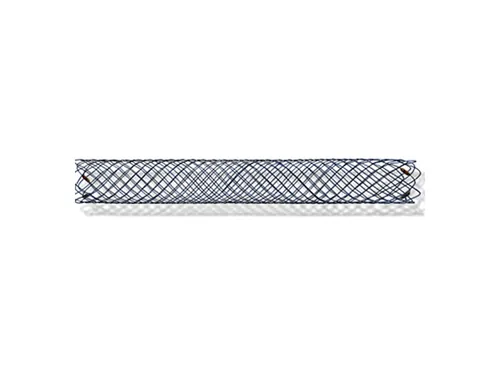
A single-wire-design self-expanding Nitinol stent (SEMS) used to relieve malignant strictures in the esophagus, colon or duodenum.
An enteral self-expanding metal stent (SEMS) is a stent placed over a guidewire to hold a narrowed segment open; by site it is called an esophageal, duodenal or colonic stent. The stent on this page is woven from a single Nitinol wire. Nitinol expands at body temperature and holds a steady radial force on the stricture.
This page lists malignant dysphagia, where an esophageal stent restores swallowing, malignant colonic obstruction as palliation or as a bridge to surgery, gastric outlet or duodenal obstruction in a patient who cannot be operated on, and an esophageal fistula that has to be sealed with a covered stent. The indication is the physician's decision.
The page lists uncovered, partially covered and fully covered versions, chosen against ingrowth and migration. A covered stent is the one used to seal an esophageal fistula. The choice is the physician's.
This page holds no MR information for the product. MR information, where there is any, is part of the instructions for use and the label, and this page does not call the stent MR safe or MR unsafe. The decision on an MR scan for a patient with a stent belongs to the physician who follows the patient and to the radiology team.
Not yet. The product is not available for order in Türkiye, so this page carries no list price either. We can share the product documentation; use the Write to us for information button at the bottom of this page.
Updated: 09.11.2026