Frequently asked questions
What does CSTD stand for?
CSTD stands for closed system drug transfer device. NIOSH defines it as a device that mechanically stops contaminants from entering the system and stops hazardous drug or vapour concentrations from leaving it. The system does this with adapters that lock into each other.
Which parts make up a CSTD?
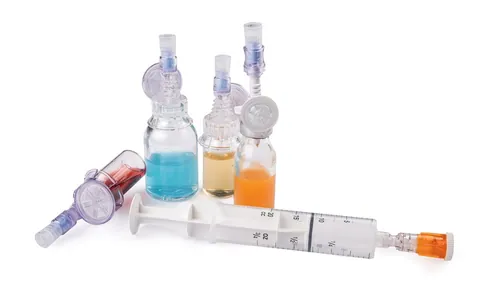
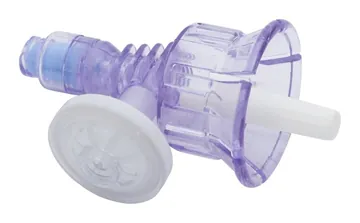
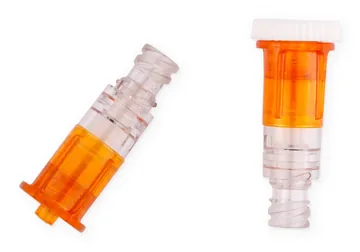
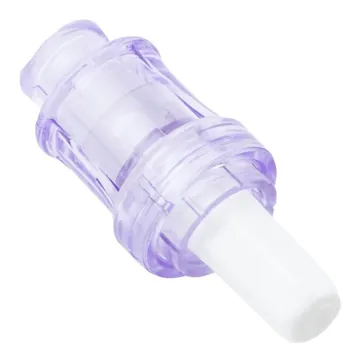
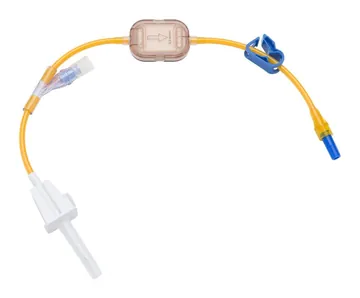
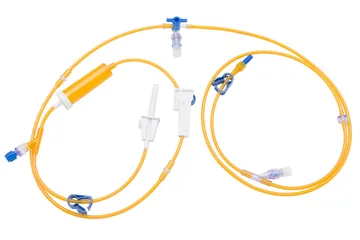
A vial adapter, a needle-free syringe adapter, a split septum needle-free connector, an oncology transfer set and an oncology infusion set work together. The vial adapters fit vial necks of 13 to 14 mm and 20 to 21 mm.
What is the difference between a vial adapter and a CSTD?
A vial adapter is one part of the system: it goes on the vial and closes it. The closed system is the whole path, where the vial adapter, the syringe adapter, the needle-free connector and the sets lock to each other from the vial to the patient.
Why is a closed system used when cytotoxic drugs are prepared?
It keeps the drug inside the path from vial to patient, so no open needle and no open drop is left where the drug is drawn, added to the bag and connected. Whether a closed system is required depends on the standards and regulations your unit follows.
How does preparation work?
1. The vial adapter goes on the vial. 2. The syringe adapter locks onto the syringe. 3. The red marks are aligned and the two lock. 4. The vial is turned over and the drug is drawn. 5. The dose goes into the bag through the bag adapter or the transfer set's needle-free valve.
How was the vapour test done?
UNIQUE laboratory used the NIOSH draft performance protocol with 2-phenoxyethanol as the surrogate and LC-MS/MS analysis; the quantification limit was 1.96 µg/L. The positive control without the system read 44.2 ppb.
How is it discarded?
The instructions for use say the set and its adapters are discarded together, without being taken apart, as a closed system.
Which CSTD brands are there?
Internationally known systems in this product class include BD PhaSeal, Equashield and Tevadaptor. This page describes the closed system supplied in Türkiye by Melekırmak. The list is not complete and implies no ranking.
Which CSTD brands have passed the NIOSH vapour test?
NIOSH does not certify closed system transfer devices. It defines the device class and published a draft vapour containment performance protocol in 2015, which manufacturers use to test their own products. A statement that a brand passed the NIOSH test therefore refers to that manufacturer's own test report. For the system on this page, the manufacturer reports a test to the NIOSH draft protocol in July 2025 in which all 20 measurements stayed below the quantification limit. To compare systems, ask each supplier for the test report, the surrogate substance and the quantification limit. This page does not rank brands.
What types of closed system transfer devices are there?
Literature on closed system transfer devices commonly distinguishes two designs: physical-barrier systems and air-filtering (air-cleaning) systems. The vial adapters on this page balance vial pressure with a 0.2 µm hydrophobic air filter, and a bellows vial adapter is listed for 20/21 mm necks. A unit chooses by its own risk assessment and the standards it follows.
When must a CSTD be used under USP <800>?
USP <800>, the United States standard for handling hazardous drugs in healthcare settings, says a closed system transfer device must be used when administering antineoplastic hazardous drugs if the dosage form allows it, and should be used when compounding them if the dosage form allows it. Whether a closed system is required in your unit depends on the standards and regulations you follow.
Does a CSTD maintain sterility?
The needle-free valve kept a 7 day microbial barrier over 35 activations in a 2021 university laboratory test, and it is listed for up to 200 activations. The 0.2 µm hydrophobic air filter of the vial adapter lets air through while the drug stays sterile. The sets are sterilised with ethylene oxide and are single use.
What does the price of the closed system transfer device depend on?
The price depends on the parts you need (vial adapters, syringe adapters, connectors, sets) and the quantity. Write to us for a fast quote, using the contact details at the foot of this page.
Who supplies closed system transfer devices in Türkiye (Turkey), and can I order in bulk or for export?
Melekırmak, an Istanbul-based medical device distributor founded in 2006, supplies closed system transfer devices to hospitals across Türkiye and answers international enquiries. Bulk and institutional orders are quoted case by case. For an export order, state the parts you need and the quantity, together with the destination country, and write to us with the contact details at the foot of this page. Availability, documentation and lead times in your country are confirmed in the reply.