Bipolar ESD: current runs from the knife tip to a return electrode on the scope tip; no grounding pad.
This page is intended for healthcare professionals.
Four parts close the bipolar circuit.

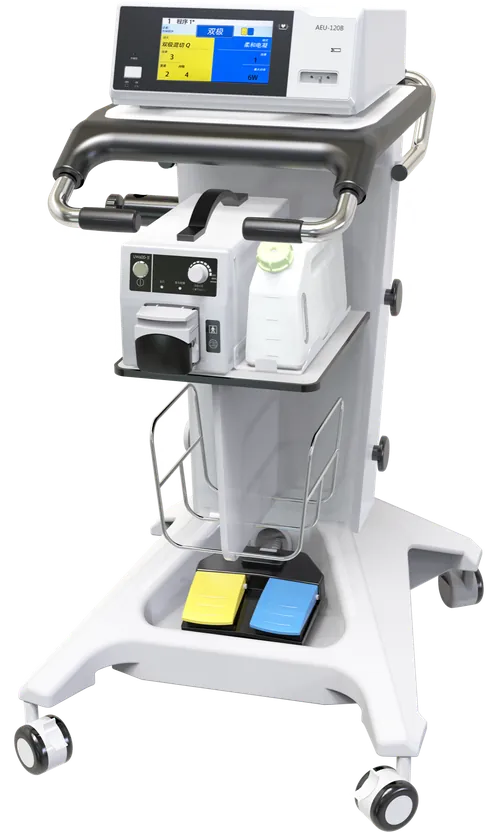
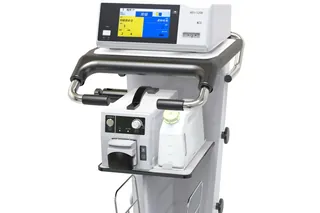
High-frequency generator on the ESD cart with the UW600 irrigation pump and foot pedals.

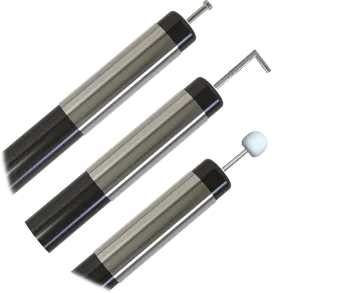
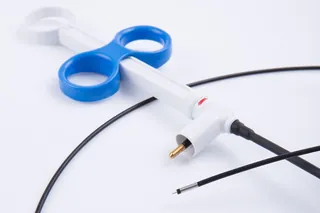
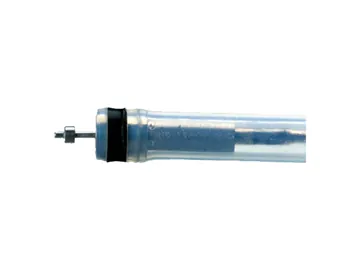
Needle, hook and disc tip variants; the disc tip grips the tissue for marking, hooking and cutting, and the end of the sheath also conducts (Chen 2022).

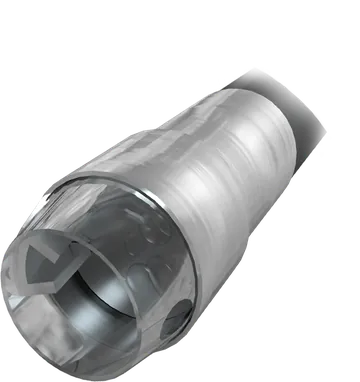
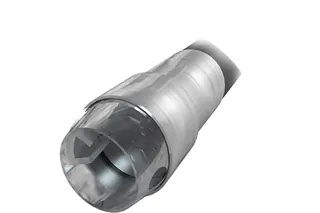
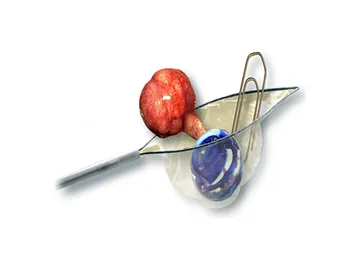
Transparent cap on the endoscope tip that carries the return electrode; the circuit closes through the mucosa it touches.

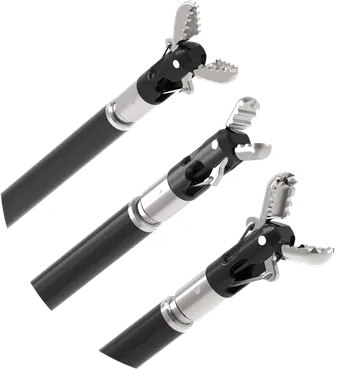
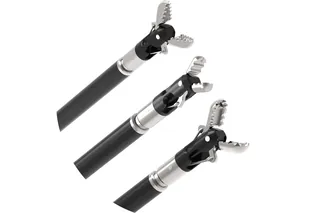
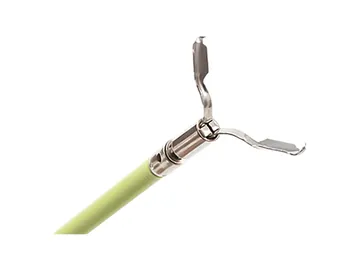
For coagulation and hemostasis in the digestive tract with high-frequency current (manufacturer indication); the picture shows the jaw variants.
ESD removes early digestive tract cancers en bloc, but a monopolar knife drives the current vertically through the wall to a pad on the body. In the thin-walled esophagus and colorectum, that vertical heat is a known risk factor for perforation.
Earlier bipolar knives kept the current at the tip but cut slowly, so monopolar stayed the standard. The AGS knife moves the return electrode onto a cap at the scope tip; in the published porcine study cutting speed did not differ from the monopolar knife, and the authors attribute this to the larger contact area.
The ESD sequence you already know; what changes is the circuit.
You select the bipolar programme and connect the knife. In the published study auto-cut was 30 W and forced coagulation 60 W, the same settings as the monopolar arm; the cart's pump feeds the irrigation.
The cap goes on the endoscope tip and touches the mucosa. Keep the knife tip close to the cap and in view: the circuit closes through that contact.
Marking, submucosal injection, circumferential incision and dissection follow the usual ESD sequence. The disc tip marks, hooks and cuts; the same knife coagulates the small vessels as you go.
Larger vessels are grasped and coagulated with the bipolar forceps (manufacturer indication).
The published comparison: 26 pigs, 19 patients with the bipolar knife, 22 monopolar patients and a thermal model; single centre.
No perforation and no immediate or delayed bleeding in the 19 patients treated with the bipolar knife; en bloc resection in all, as in the 22 monopolar patients.
Read publication → 81 to 85%Depth of thermal damage with the bipolar knife as a share of the monopolar knife's at the same power.
Read publication → 39/39En bloc resections with the bipolar knife and no perforation; cutting time, cutting speed, wound size and histology did not differ from the monopolar knife.
Read publication →Melekırmak Medical is the Türkiye distributor of AGS MedTech; AGS hemoclips and ERCP consumables are already part of our endoscopy portfolio. The Bipolar ESD system is being added to it. The cap on the scope, the different circuit and the habit of keeping the tip in contact are worked through with the team, and we do that before the first case.
We already do this: we read the published study with your ESD team and answer the technical questions on the generator, the cap and the knife. A demonstration in your unit, hands-on practice on a model, the manufacturer's online training for your endoscopists and our clinical team in the room for your first cases: the path we follow for every new system.
Sources: Frontiers in Medicine 2022, Chen, n=19
Updated: 29.09.2026