Frequently asked questions
What is an elastomeric infusion pump used for, and is it the same as a chemotherapy pump or an infusor?
It gives a drug to the patient slowly at a pre-set constant rate. An elastic reservoir pushes the drug through a flow restrictor tube; there is no battery and no programming, and each item has one fixed rate. In everyday language the same type of pump is called a chemotherapy pump, an infusor or a balloon pump.
How long does an elastomeric pump take to empty, and what does a 2-day pump mean?
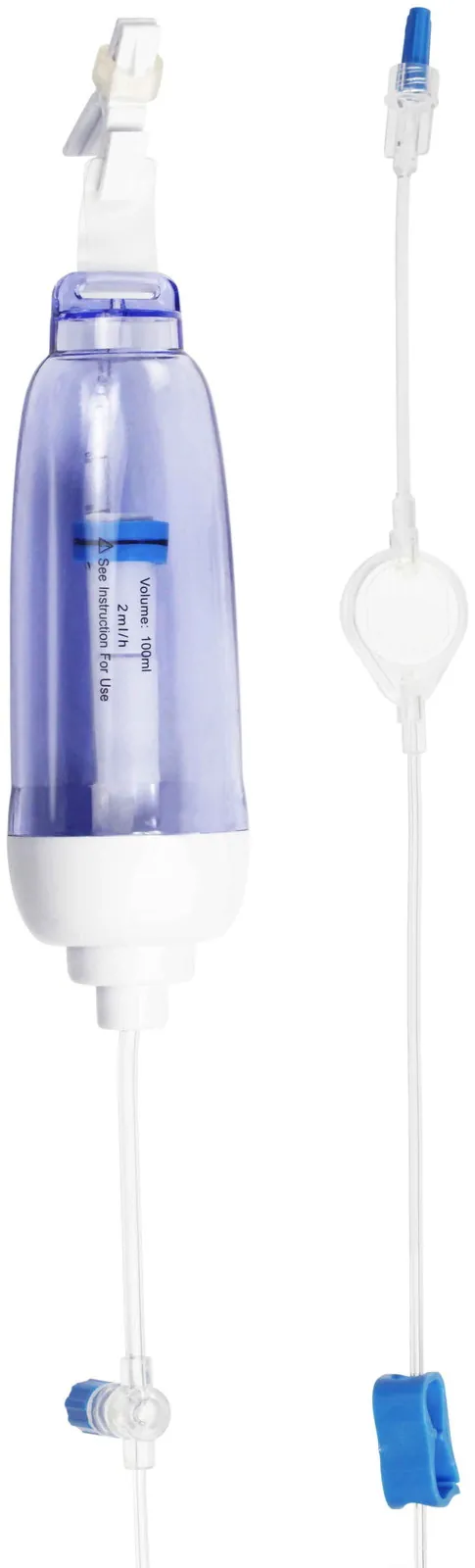
The bottle volume and the flow rate set the duration: the nominal volume divided by the nominal rate. A 100 ml bottle at 2 ml/h runs about 50 hours, close to two days. The real time varies a little with the plus minus 10 per cent rate band, the temperature and the other factors named in the question on early or late finishing.
How is an elastomeric pump different from an electronic infusion pump?
An elastomeric pump runs without electricity and is not programmed. A flow restrictor tube sets the rate, there is one fixed rate per item, and there is no rate dial and no bolus button. An electronic infusion pump runs on a battery or on mains and its rate is set by a program.
What is the difference between a hard-shell and a soft-shell elastomeric pump?
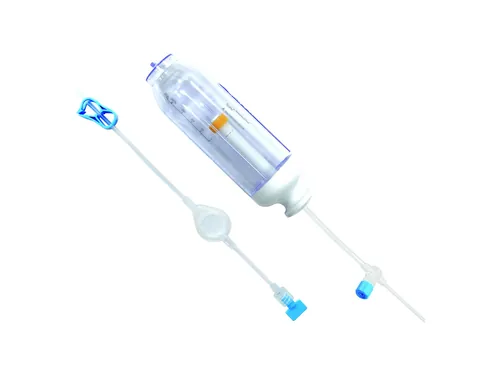
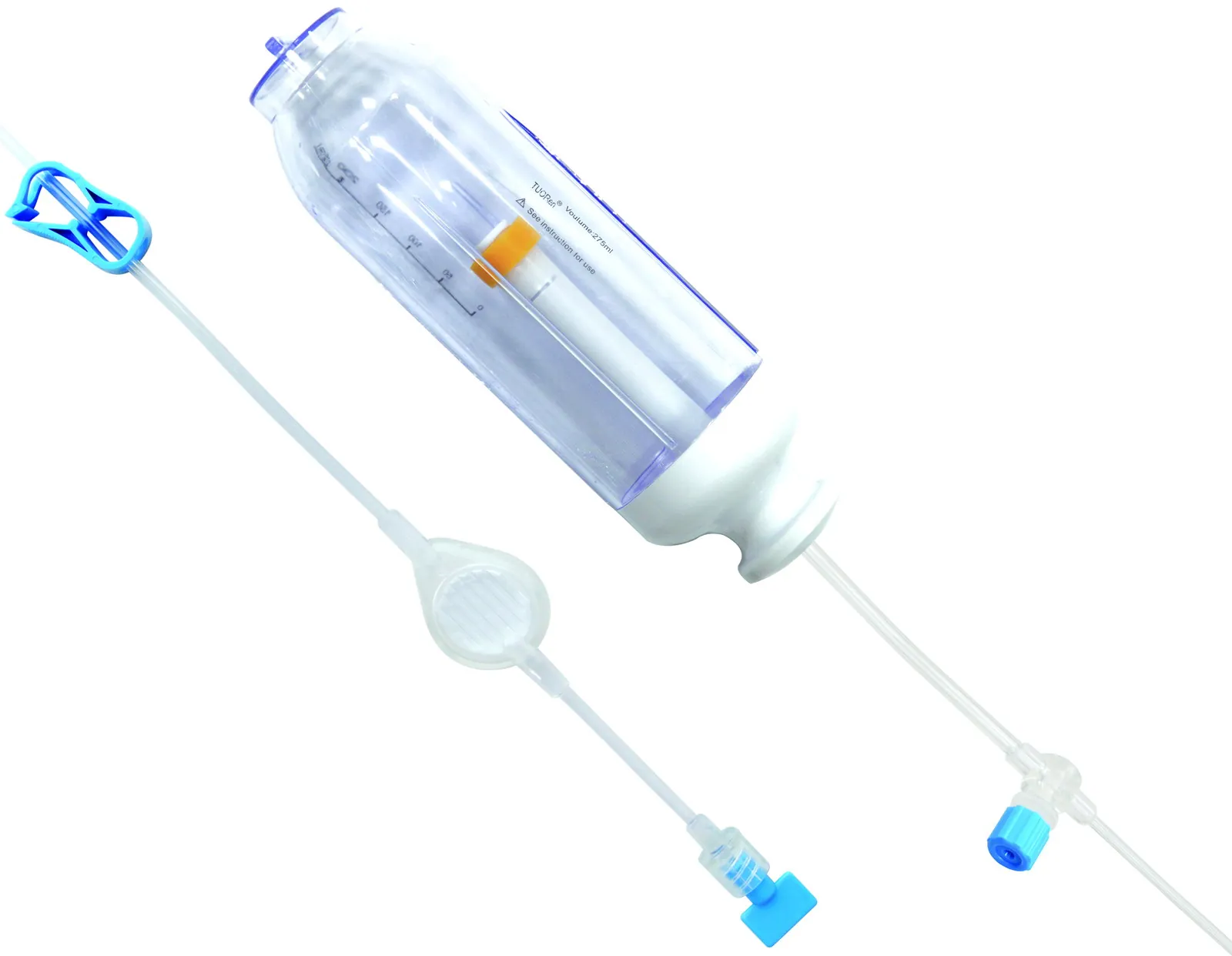
Both are single-use pumps without battery or programming: an elastic reservoir pushes the drug through a flow restrictor tube at one fixed rate per item, within plus minus 10 per cent of the nominal rate. On the hard-shell type the reservoir sits in a rigid bottle, clear on this standard pump and light-blocking on the light-protected pump. On the soft-shell type the outer body is soft, takes less room in storage and in transport, and the infused volume is followed on the body of the pump; Luer and NRFit connections are listed for the soft family. The hard-shell pumps on this site come in 60, 100 and 275 ml, and the soft-shell pump is the light-protected type in 100 and 275 ml. The data are from the manufacturer's catalogues and instructions for use.
Which elastomeric infusion pump brands are there?
Elastomeric infusion pumps are made by several companies; Baxter and B. Braun are among the internationally known ones. The pumps on this site are made by Tuoren Medical and supplied in Türkiye by Melekırmak. The list is not complete and implies no ranking, and this page does not compare flow accuracy, price or availability between brands.
What does the price of the elastomeric infusion pump depend on?
The price depends on the model, volume and quantity. The volume (60, 100 and 275 ml), the flow rate and the filter pore make up the catalogue number. Use the Request an export quote button in the Export and Bulk Orders section of this page for a fast quote.
What sizes does the elastomeric pump come in, in volume and flow rate?
Bottles of 60, 100 and 275 ml, at 1, 1.5, 2, 4 and 5 ml/h, one fixed rate per item. The models table gives the volume, the rate and the filter pore of every catalogue number.
Can a light-sensitive drug be given with this pump?
This type carries no light protection. The type whose reservoir, line and accessories are protected from light together is listed as a separate item, with a rigid body and with a soft body.
Can the patient shower with the pump?
The instructions for use do not cover showering; they say only that cleaning agents such as soapy water or alcohol must not touch the filter, which can then leak. Our patient guide tells the patient to shower only if the nurse allows it, to keep the pump in a plastic bag outside the shower and never to put the pump or the line in water.
What does the team do if the pump leaks?
If the pump body or one of its parts breaks or leaks, the instructions say to stop the infusion by clamping the tubing, inform the responsible caregiver and replace the pump if necessary. Our patient guide tells the patient to close the clamp, put on gloves, use the spill kit the hospital gave them and call the hospital straight away. The spilled drug is cleaned up under your unit's own spill procedure.
What if the pump finishes early or late?
The mean rate stays within plus minus 10 per cent of the nominal rate and can be faster than stated in the first 1 to 2 hours. Temperature, the height of the pump body against the flow restrictor, the drug's composition, concentration and viscosity, a fill other than the nominal volume and a filled pump kept longer than 8 hours before the start can all change the time. At the end at most 3 ml stays behind, tubing included. Our patient guide tells the patient to call the hospital if the pump finishes much earlier than they were told, or is still full well after the expected time.
Can the pump be refilled or used again?
No. The pump is for single use: it is not used again and not re-sterilised. The instructions warn that reuse or re-sterilisation can make the flow unpredictable and cause infection in the patient. After use it is discarded under local regulations.
How is the pump stored before use?
In a cool, dry and well-ventilated place, protected from moisture and direct sunlight. It is not frozen, because freezing can damage the tubing and the plastic parts. Shelf life is 5 years. A refrigerated pump is brought to room temperature before use; a large-volume pump can take up to 12 hours, and dew inside the case meanwhile does not affect its use.
Who supplies elastomeric infusion pumps in Türkiye (Turkey), and can I order in bulk or for export?
Melekırmak, an Istanbul-based medical device distributor founded in 2006, supplies elastomeric infusion pumps to hospitals across Türkiye and answers international enquiries. Bulk and institutional orders are quoted case by case. For an export order, state the volume (60, 100 or 275 ml), the flow rate and the quantity, together with the destination country, and use the Request an export quote button in the Export and Bulk Orders section of this page. Availability, documentation and lead times in your country are confirmed in the reply.
What is the HS code for a disposable elastomeric infusion pump?
This page does not state an HS code. The customs tariff line depends on the exact model and on the tariff of the destination country. Ask for the HS code of your model together with an export quote: give the model, the quantity and the destination country, and use the Request an export quote button in the Export and Bulk Orders section of this page.