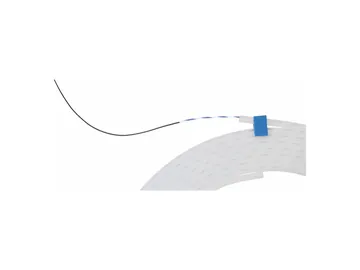
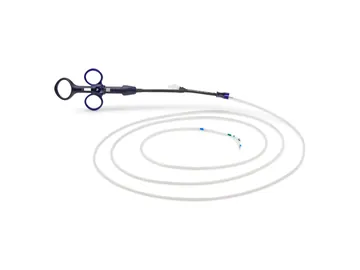
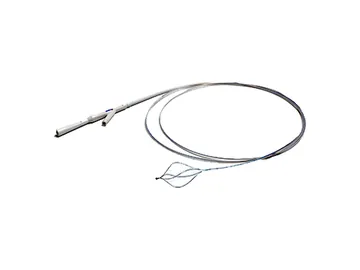
A short wire ERCP system (also called short-wire exchange) holds the guidewire locked at the scope, so instruments come off the wire without being pulled back over its full length. ShortTrack is such a system: a locking device on the scope plus catheters, wires, balloons, baskets and stent sets for it. One operator changes instruments without losing ductal access.
This page is intended for healthcare professionals.
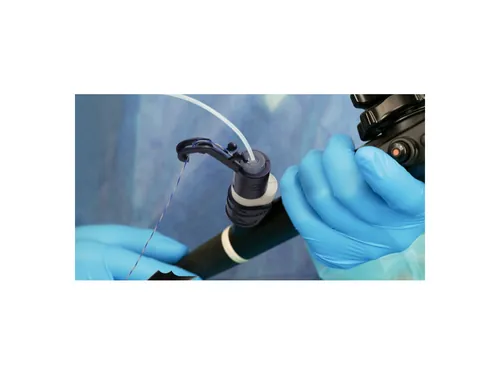
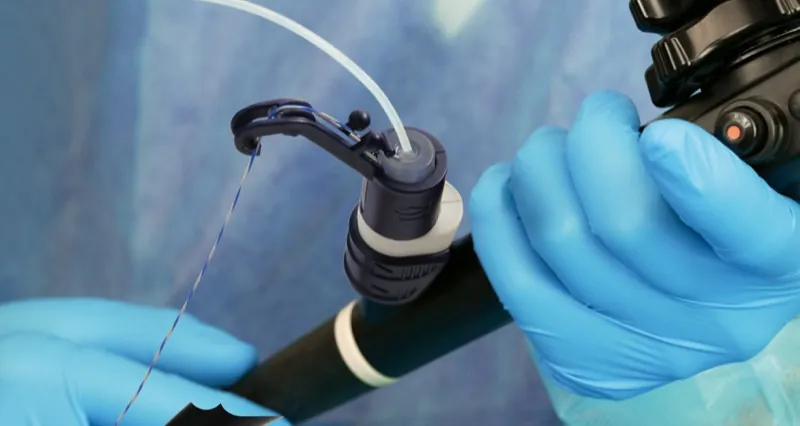
A short-wire ERCP platform: the guidewire is locked at the scope and instruments come off it without being pulled back over its full length.
A short wire ERCP system keeps the guidewire locked at the scope. The instruments have a tear-away wire channel, so each instrument comes off the wire without pulling the wire back. One operator can therefore change instruments without losing ductal access. The short-wire technique is also known as rapid exchange (RX) in the literature and in everyday language.
The difference is how the wire is held and how an instrument leaves it. In this system the wire is held at the scope and the instrument comes off through a tear-away channel, without being pulled back over the full length of the wire. The wire also stays off non-sterile surfaces during the exchange. The choice of system is the unit's and the physician's.
ShortTrack consists of a locking device on the scope plus catheters, wires, balloons, baskets and stent sets for it. The locking device fixes up to two wires with 360 degree fixation in the working channel.
The uses on this page are a full ERCP run on short wires (ERCP cannulation, sphincterotomy, stone clearance and drainage), emergency lithotripsy through the scope without withdrawing the duodenoscope, and a busy list where instrument exchange time decides how many cases fit the day.
Not yet. The ShortTrack short wire ERCP system is not available for order in Türkiye. We can share the product documentation; use the button on this page to write to us.
Updated: 09.11.2026